How Rugged In-Vehicle Tablets Like the V10J Are Transforming Port Terminal Efficiency
In the high-stakes environment of modern port terminals, operational delays are not an option. With container handling demands rising and margins tightening, terminal operators are turning to fully rugged in-vehicle computing solutions to maintain seamless workflow continuity. Among these, the ONERugged V10J has emerged as a pivotal asset in transforming how loading, unloading, and fleet coordination are managed under extreme conditions.
Challenges of Container Management in Harsh Marine Environments
Port operations are subjected to relentless environmental stressors—salt-laden air, extreme temperature fluctuations, constant vibration, and exposure to rain and dust. Traditional commercial-grade computers, when mounted on cranes or yard trucks, often fail prematurely under such duress. When systems crash mid-operation, cascading inefficiencies occur: mislocated containers, delayed dispatches, and compromised data synchronization with central logistics platforms.
At Zhanjiang Wharf, where precision timing directly correlates with profitability, even minor disruptions were found to impact throughput. The need arose for a computing platform capable of uninterrupted performance despite mechanical shocks, prolonged sun exposure, and frequent power cycling—all while maintaining compatibility with a newly upgraded Windows 10–based yard management system.
Why Standard Tablets Fail in Vehicle-Mounted Port Applications
It is not uncommon for off-the-shelf tablets to be retrofitted into vehicle fleets due to their lower initial cost. However, once deployed, they are rarely built to withstand repeated impacts from crane movements or sudden stops. Furthermore, passive cooling mechanisms become overwhelmed in tropical climates, leading to thermal throttling. Without IP65-rated sealing, moisture and particulate ingress further degrade internal components over time.
- Lack of MIL-STD-810G certification results in structural failure under shock and vibration
- Inadequate sunlight-readable displays impair usability during daytime operations
- Poor wireless resilience disrupts real-time communication with control centers
Deploying the V10J as a Fully Rugged In-Vehicle Computing Solution
After extensive field testing across multiple vendors, Zhanjiang Wharf selected the ONERugged V10J—a purpose-built vehicle PC engineered for mission-critical transportation ecosystems. Unlike semi-rugged alternatives, this device was designed from the ground up to meet industrial durability benchmarks without compromising on processing power or connectivity.
Mounted across gantry cranes, reach stackers, and yard trailers, the V10J functions as a centralized digital console, integrating seamlessly with enterprise resource planning (ERP) and terminal operating systems (TOS). Its fanless architecture ensures silent, maintenance-free operation, while the hot-swappable dual battery system allows for 24/7 uptime during shift rotations.
Real-Time Data Flow Between Operators and Control Centers
Enabled by advanced WLAN modules supporting 802.11ac and MIMO technology, the V10J maintains persistent, low-latency connections to backend servers. This allows for instant push notifications regarding job assignments, dynamic rerouting, and live updates on container positioning. Operators interact through a responsive 10.1-inch HD capacitive touchscreen—visible even in direct sunlight—reducing input errors and accelerating task completion.
Graphical overlays display optimal movement paths, stacking priorities, and rehandling forecasts, all accessible via an intuitive interface. Critical status changes, such as equipment downtime or hazardous weather alerts, are broadcast system-wide using integrated OTA update capabilities.
Performance Advantages That Drive Terminal Productivity
The integration of the V10J into daily workflows has yielded measurable improvements in key performance indicators at Zhanjiang Wharf. By eliminating reliance on paper logs and intermittent radio communication, decision latency has been reduced significantly.
Key Operational Benefits of Industrial-Grade In-Cab Tablets
Made possible through robust hardware-software synergy, the following outcomes have been observed:
- Improved container tracking accuracy: GPS and RFID integration enables precise geolocation logging within ±2 meters.
- Enhanced operator efficiency: Touch-based job validation cuts average transaction time by up to 40%.
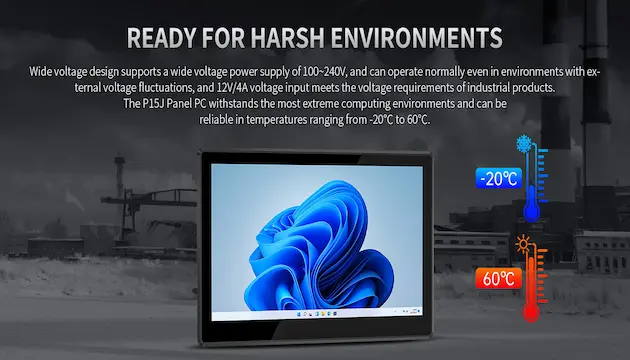
- Reduced equipment downtime: Sealed design and wide temperature tolerance (-20°C to 60°C) prevent environmental failures.
- Seamless software interoperability: Native support for Windows 10 IoT Enterprise ensures stable execution of complex TOS applications.
Additionally, remote diagnostics and over-the-air firmware updates minimize the need for on-site IT intervention, enabling scalable deployment across large fleets.
Future-Proofing Port Infrastructure with Rugged Computing
As automation and Industry 4.0 principles gain traction in maritime logistics, the role of ruggedized edge devices becomes increasingly strategic. Devices like the V10J from ONERugged serve not only as human-machine interfaces but also as data aggregation nodes for predictive maintenance, AI-driven scheduling, and IoT-enabled asset tracking.
With modular expansion options—including CAN bus support, smart card readers, and external antenna ports—the V10J adapts to evolving terminal requirements without necessitating full hardware replacement.
For ports aiming to achieve leaner operations, reduce error rates, and future-proof their digital infrastructure, investing in certified rugged vehicle PCs is no longer optional—it's foundational.


评论
发表评论