Rugged Tablets with 1000 Nits for Energy and Utilities
Field teams in energy and utilities don’t get the luxury of controlled indoor lighting. Whether it’s a substation inspection at noon, a wind farm turbine check under open sky, or a pipeline survey across desert terrain, screen visibility isn’t a convenience — it’s a prerequisite for safe, accurate data capture. That’s why brightness specs like 1000 nits matter far more than marketing claims: they directly determine whether a technician can read a live sensor overlay, verify a barcode on corroded equipment, or confirm a checklist step without shading the screen with their hand.

Substation Monitoring with 1000 Nits Outdoor Readability
On-site engineers routinely face ambient light levels exceeding 8,000–10,000 lux in direct sun — especially during summer months in high-irradiance regions. Consumer-grade tablets (typically 300–500 nits) wash out completely under those conditions. Devices like the Onerugged M105Q and M80J deliver 1000 cd/m² (equivalent to 1000 nits) on their 10.1" and 8" displays — not as peak burst output, but sustained, full-screen luminance. This isn’t just about contrast; it’s about consistent legibility during multi-hour shifts where squinting or repeated screen repositioning introduces fatigue and error risk.
Why brightness alone isn’t enough — and what pairs with it
- IPS panel architecture: All 1000-nit models listed use IPS LCDs, delivering wide viewing angles (up to 178°) so operators can glance at the screen from awkward positions — say, while kneeling beside a transformer cabinet or reaching into a control panel.
- Matte anti-glare coating: Explicitly referenced in the display specs for models like M80J and M105Q, this reduces specular reflection without sacrificing touch sensitivity — critical when gloves or damp fingers are involved.
- Thermal headroom: Sustaining 1000 nits requires stable thermal management. These units use passive heatsinking and low-TDP processors (e.g., Intel Celeron N5100, RK3568), avoiding fan noise or thermal throttling during prolonged outdoor use.
This combination — real-world nit rating + IPS + matte finish + thermally conservative design — is what separates deployable hardware from showroom spec sheets.
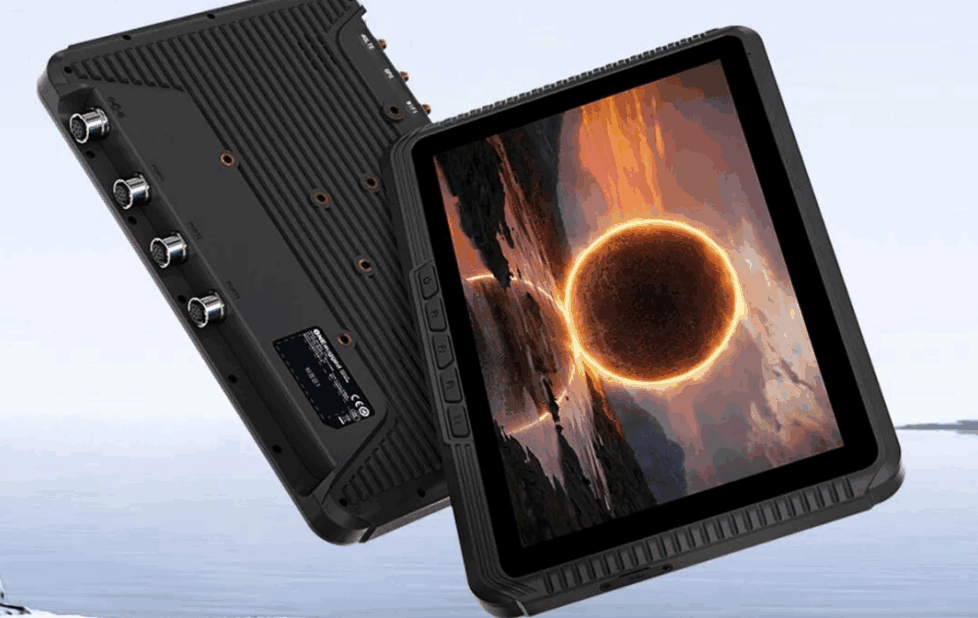
Field Mobility in Remote Grid Infrastructure with Rugged Tablets
Energy infrastructure spans vast, often unsheltered geographies: transmission corridors, offshore substations, rural distribution hubs. A tablet that survives a 1.2-meter drop onto gravel matters less than one that stays functional after weeks of temperature cycling between -20°C overnight and +45°C midday. While the scraped material doesn’t list IP or MIL-STD ratings, the consistent inclusion of outdoor rugged as a dedicated product category — alongside explicit use cases like Energy and Utilities — signals design intent aligned with those environments.
For procurement teams evaluating long-term reliability, brightness stability over time is a proxy for overall display subsystem quality. Panels rated for 1000 nits typically use higher-grade LED backlights and driver ICs — components less prone to luminance decay after 2–3 years of daily field use. That’s why rugged tablets with verified 1000-nit performance are increasingly specified in utility RFPs alongside environmental certifications — not as standalone features, but as evidence of engineering rigor.
Software Integration for Utility Workflows
Brightness means little if the OS or application layer can’t keep up. The M105Q and M80J both ship with Android 14/GMS and Ubuntu 22.04.4 respectively — not stripped-down custom ROMs. That enables seamless integration with existing enterprise mobility stacks: MDM enrollment via Android Enterprise, secure kiosk mode for SCADA interface launchers, and OTA updates for firmware patches without requiring physical device retrieval. For IT admins managing fleets across multiple grid zones, this eliminates the need for side-loaded APKs or manual image flashing — a real operational simplification reflected in lower support ticket volume.
Those same devices also support optional rugged tablets accessories like vehicle mounts and hot-swappable batteries — features frequently requested in transportation and field service deployments. And for teams operating in extreme cold or heat, the deploying rugged tablets in polar reference suggests broader environmental validation beyond standard commercial temperature ranges.


评论
发表评论