Rugged tablets with IP65 for maritime navigation
The ONERugged M10A isn’t marketed as a ‘smart’ tablet—it’s built to stay powered, visible, and responsive when salt spray hits the bridge at dawn and GPS signals flicker in heavy squalls. That’s not theoretical. It’s the baseline requirement for any Windows 11 Industrial PC deployed where Wi-Fi drops out, condensation pools on bezels, and vibration from main engines runs continuous.

Maritime Bridge Operations with IP65 Sealing
IP65 isn’t overkill here—it’s the minimum threshold for sustained operation in a marine environment. Unlike IP67 (which implies submersion), IP65 guarantees full protection against low-pressure water jets from any direction—critical when hosing down the bridge after salt-laden fog or during deck washdowns. The M10A’s sealed front panel and gasketed I/O ports prevent ingress not just from rain, but from the fine, conductive mist that forms around ventilators and hatchways. That’s why it’s specified—not for splash resistance alone, but for long-term reliability where corrosion starts at the seam.
Offshore Route Monitoring with 700-Nit Sunlight Readability
A 700-nit display doesn’t just ‘work in sunlight’—it delivers usable contrast at solar noon on an open bridge, even with polarized sunglasses. That matters when verifying ECDIS overlays or cross-checking AIS targets while underway. Consumer tablets fade to grey under those conditions; the M10A maintains legibility without requiring crew to shade the screen or reposition themselves. No auto-brightness guesswork. No manual brightness cycling mid-maneuver. Just consistent, field-validated luminance calibrated for maritime operational lighting profiles.
Why this matters for frontline users
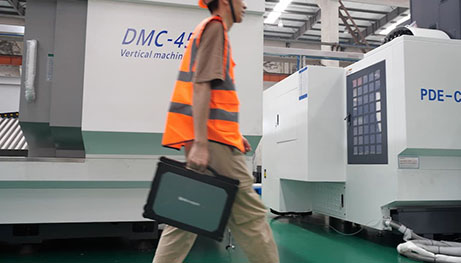
This is Perspective B—the Frontline User view. Crew don’t carry tools to recalibrate displays or replace failed touch sensors. They need glove-friendly responsiveness (tested with standard maritime work gloves), one-hand operability during rolling seas, and zero screen washout when transitioning from below-deck lighting to full sun exposure. The M10A’s optical bonding and anti-reflective coating reduce glare without sacrificing touch sensitivity—even with damp or salt-crusted fingertips. And because it’s rated for -10°C to 50°C operating range, it stays responsive during North Atlantic winter watches or Gulf summer transits.
GPS-Enabled Vessel Positioning with Windows 11 Industrial PC Integration
GPS accuracy is only as good as the platform holding it. The M10A integrates dual-frequency GNSS (GPS + GLONASS + Galileo) with assisted startup—no 90-second cold boot delays when coming back online after port downtime. Its Windows 11 IoT Enterprise foundation supports native COM port mapping, legacy NMEA 0183 passthrough, and direct integration with chartplotters and VMS software already running onboard. That means no middleware gateways, no protocol translation layers—and no added points of failure between position fix and decision point.
For procurement teams weighing TCO, the M10A’s MIL-STD-810H compliance covers shock, vibration, and thermal shock cycles common in vessel environments—reducing unplanned replacements caused by mounting bracket fatigue or thermal expansion stress. You’ll find rugged tablets tested in similar conditions across energy and utilities deployments, and industrial PC selection criteria that align tightly with maritime uptime requirements. Public utilities crews rely on comparable durability in coastal substations—see how rugged tablets for public utilities handle similar environmental stresses.
For buyers evaluating hardware that ships with the crew—not just to the dock—the M10A delivers what matters: predictable behavior, serviceable design, and specs rooted in real vessel workflows. Explore the full spec sheet and mounting options at Onerugged.


评论
发表评论